Crowns, which are commonly referred to as “caps”, have multiple benefits. Crowns fully cover existing teeth which requires us to reduce the size of the tooth to allow space for the new material. There are several reasons we may recommend a crown. One reason is that the tooth has or will be having a root canal. Teeth are more susceptible to fracturing after root canals and a crown will help protect the tooth, improving its longevity. Another reason may be that the tooth has already had multiple large fillings which can also make it susceptible to fracturing or recurrent cavities. We also do crowns or veneers to improve esthetics for patients. Crowns can help give the appearance of a more uniform size and color to teeth.
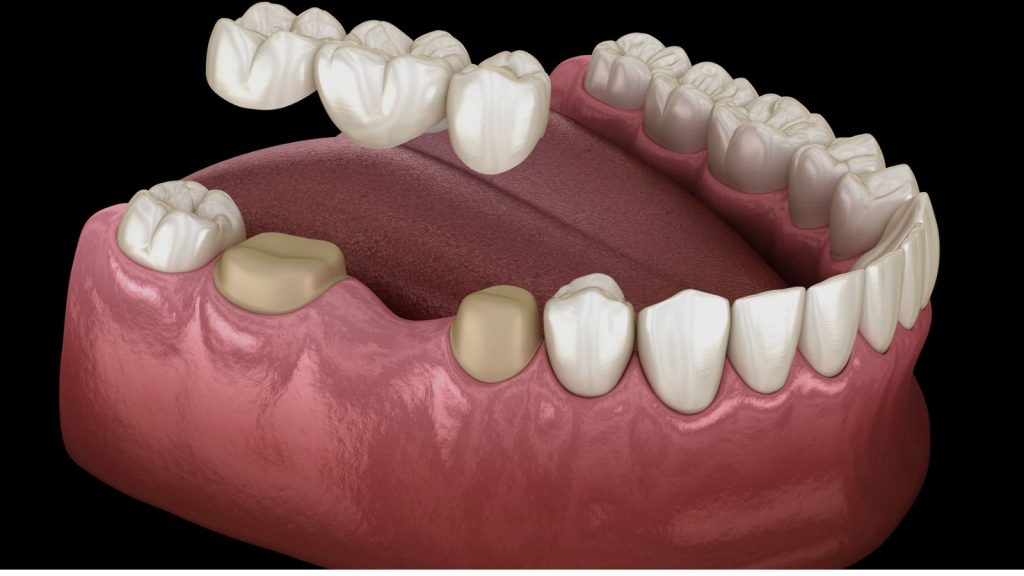
Bridges are advised as an option to replace a missing tooth. Bridges utilize the teeth on either side of a space as anchors. Those teeth are prepared for crowns and a bridge is fabricated with a crown fused in between two crowns and then cemented permanently in place. Bridges can be a highly successful way of replacing a missing tooth or teeth and our office will discuss this option with patients on a case-by-case basis.
Both crowns and bridges require two visits to complete. On the first visit we prepare the area for the crown or bridge and then fabricate a temporary restoration. A professional lab will fabricate the final restoration for us and at our second visit we’ll cement the crown/bridge in place so long as we’re satisfied with the fit and appearance.
Dental materials and technology are continuously improving. In our office we primarily utilize a strong material called Zirconia to fabricate full porcelain crowns and bridges. On occasion we may recommend a gold or a metal/porcelain hybrid restoration. If that is needed, we’ll discuss it prior to fabricating the restoration. Our goal is to create a restoration that will be durable, long lasting, and natural looking.
